
Nikro Air Duct Cleaning in Lower East Side: A Homeowner’s Guide
Most homeowners shopping for duct cleaning in Lower East Side have no frame of reference when a contractor names their equipment. “Nikro” could mean anything. It’s a fair question, and it’s the right one to ask: Nikro’s commercial power vacuum units move enormous volumes of air compared with consumer shop-vacs, and that suction is what actually pulls loose debris off duct walls and out of the system. In this guide, we break down what Nikro equipment does mechanically, why the specs matter in a Lower East Side apartment, and which questions separate a real professional setup from a brand name on an invoice.
If you’d rather skip the research and talk to someone who can size the job for your unit, call (866) 369-3604.
Key Takeaways
- Nikro commercial HEPA vacuums pull many times the airflow of even a high-end consumer shop-vac, which matters for actually extracting debris rather than stirring it up.
- In a Lower East Side multi-unit building, HEPA filtration and sealed extraction prevent cross-contamination between apartments.
- Contact agitation (rotating brush or contact vacuum) plus high-CFM extraction is the baseline for professional work, per the NADCA ACR standard.
- Ask any contractor for the specific Nikro model and CFM rating they’ll use, not just the brand name.
What Do Nikro’s CFM Ratings Actually Mean for a Lower East Side Apartment?
CFM stands for cubic feet per minute: the volume of air a vacuum moves. The practical rule of thumb in the trade is that you want a vacuum that can exchange the air volume of the duct system several times per minute to pull debris into the collection unit rather than just loosen it. A typical one-bedroom Lower East Side apartment has a modest duct footprint, but a prewar walk-up with long horizontal runs and multiple risers can hold hundreds of cubic feet of ductwork. Run the math on the system volume, not the apartment square footage. A higher-CFM machine gives more extraction headroom, but it also needs proper HEPA filtration to keep the exhaust clean. If a contractor can’t tell you the model number and rated CFM of the vacuum they’ll bring, that’s your cue to ask the follow-up. Most Lower East Side buildings were built decades before today’s duct cleaning standards, so there’s no substitute for a machine sized to the actual layout.
How Does Nikro HEPA Filtration Prevent Cross-Contamination in Multi-Unit Buildings?
This is the part of the story that gets skipped in sales pitches. A duct cleaning that pulls debris loose but doesn’t capture it just moves the problem. In a multi-unit Lower East Side building, that matters enormously, because exhaust air from one apartment’s system can drift through shared corridors or into adjacent returns. Nikro HEPA vacuum units are built to trap fine particulates in a sealed filter, so what gets loosened gets captured, not redistributed into the air your neighbors breathe. The same principle applies to the Abatement Technologies air-scrubbers we deploy for sanitizing work: they’re the same class of equipment used in remediation projects, where clean-air discipline is the entire point. Co-op boards and building managers in Lower East Side often want a written scope that specifies filtration before they’ll approve access. The answer to “will you make my apartment worse before it gets better” is a HEPA-rated vacuum, not a shop-vac with a hose taped to the exhaust. That’s also one reason professional-grade equipment matters: consumer units simply don’t offer the sealed filtration that multi-family work demands.
What Nikro Tool Attachments Are Used for Different Duct Configurations?
Duct cleaning is not one tool applied everywhere. The configuration of your ducts dictates the approach, and a professional setup uses different attachments depending on what’s in the walls.
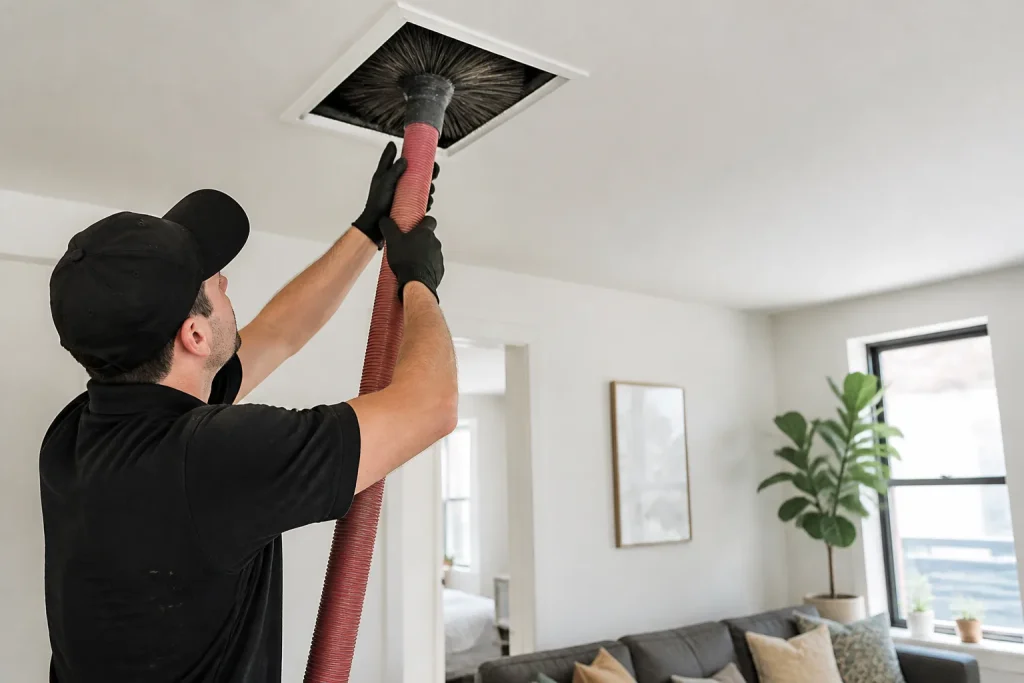
- Sheet metal duct: rotating brush heads mounted on a flexible whip, driven by the Rotobrush rotary contact cleaning system, loosen debris bonded to the duct walls before the vacuum extracts it. Rigid metal ducts respond well to this agitation.
- Flexible duct: contact vacuuming with a specialized nozzle, softer pressure, because the corrugated interior of flex duct holds debris differently and brushes can damage the liner if applied wrong.
- Camera inspection: a push camera run through the ductwork to verify before-and-after condition, especially valuable in Lower East Side buildings where ducts have been patched or rerouted over the years.
- Access ports: the technician cuts and reinstalls service openings where the system needs them, then seals properly so the ductwork stays airtight.
The right attachment set is a sign the contractor has done this work in varied housing stock. It also connects directly to duct repair and sealing: once the cleaning is done, any gaps at joints and boots get addressed so the system isn’t leaking conditioned air afterward.
Why Do NADCA-Certified Contractors Specify Professional Equipment in Their Estimates?
Because the equipment brand in an estimate tells you something about process discipline. NADCA’s assessment, cleaning, and restoration standard does not name a specific brand, but it does require source removal rather than sealing debris in place, verified cleaning, and proper containment. Contractors who follow that standard specify equipment that meets the functional requirements, and the brands they choose (Nikro, Rotobrush, Abatement Technologies) are the tools built to do it. When a written estimate names a specific machine and model rather than “professional equipment,” it’s a signal the contractor plans the job rather than improvising it. In our experience, the estimates that detail equipment are also the ones that scope repair, sealing, and sanitizing honestly. The Lower East Side market has plenty of operators offering a flat price and a hose; the ones who specify their machinery tend to be the ones who can also explain what they’ll do if the camera finds a crushed run or a disconnected joint. Ask what NADCA standard the contractor follows, and whether their equipment list matches the scope of the work.
What Questions Should You Ask Any Contractor About Their Nikro Equipment?
The brand name alone isn’t enough, because Nikro makes a range of vacuums from portable units to full commercial rigs. A few direct questions separate commercial-grade from entry-level under the same label.
- What is the exact model number of the Nikro vacuum you’ll bring?
- What is its rated CFM, and how does that compare to the duct volume of my system?
- Is it HEPA-rated, and can you show me the filter housing and seals?
- Will you use a rotary brush or contact vacuum, and which fits my duct material?
- Do you offer camera inspection before and after the cleaning?
- Will you provide before-and-after photos of my ducts?
- Is duct repair and sealing included or available if you find leaks?
Anyone who hedges or says “we use the good stuff” without specifics is probably not going to disappoint you with detail on the job itself. A professional should welcome these questions. While you’re at it, ask about the scope of related work: dryer vents and HVAC coils are part of the same air pathway, and cleaning the ducts without checking those is like vacuuming one room and calling the house clean. When you’re ready, you can read more about our dryer vent cleaning or the full HVAC cleaning work we scope alongside the duct cleaning.
When Should You Call a Pro Instead of Just Running a Consumer Vacuum?
Several signals point to a job that needs extraction equipment, not a homeowner with a shop-vac:
- Visible dust streaking out of supply registers when the system runs
- A musty or stale smell that returns after vacuuming the vents
- Allergy symptoms that flare in specific rooms
- A recently completed renovation or a move into a building with unknown cleaning history
- High energy bills with no other explanation (leaky ducts are a common culprit in older buildings)
- Dryer taking longer than usual to dry a load: that’s a dryer vent issue, not a duct one, but it’s part of the same system
If you’re in a Lower East Side walk-up and the duct runs are a mystery to you, that’s the point at which a professional assessment makes sense. If you’d like to know how a full cleaning is scoped, here’s air duct cleaning as we approach it.
Related services in Lower East Side:
The Bottom Line
The equipment a contractor brings is not trivia. Nikro HEPA vacuums are built for extraction and capture; Rotobrush rotary systems are built for contact cleaning; Abatement Technologies air-scrubbers are the class of gear used in remediation. That combination is the difference between a duct cleaning that matters and one that just stirs dust around the apartment. If you’re in Lower East Side and need help, Air Duct Cleaning Lower East Side offers free estimates. Call (866) 369-3604. We answer 24/7, with fast dispatch from 7am to 7pm, Sunday through Friday. Every job is quoted at one flat price per system before work starts, and you get before-and-after photos of your own ducts.
Frequently Asked Questions
Air duct cleaning in Lower East Side is typically quoted as a flat price per system based on the number of registers, the system layout, and whether repair or sanitizing is included. The written estimate sets the final price before any work begins. Call (866) 369-3604 for an exact quote. Estimates are free.
Usually because the equipment and scope are different. A low quote often means a portable vacuum without HEPA filtration, no rotary agitation, and no duct repair. The brand on the invoice may say Nikro, but the model may be an entry-level unit that isn’t sized for a multi-run apartment. Ask for the model number and CFM before you compare prices. Call (866) 369-3604 to talk through what a proper scope covers.
Before-and-after photos of your ducts, plus camera inspection where the layout allows. A professional scope includes both, and you should be able to review them when the job wraps. We provide photos of your own ducts, not stock images. Call (866) 369-3604 for a free estimate.
The general industry guidance is every three to five years, or sooner after a renovation, a move, or visible dust blowing from the registers. Multi-unit buildings and pet-heavy apartments often need the shorter end of that range. If you’re unsure, an assessment is the sensible starting point, and the estimate is free. Call (866) 369-3604.
Written by the team at Air Duct Cleaning Lower East Side.
Need Air Duct Cleaning Help?
Call Air Duct Cleaning Lower East Side - the local pro we connect you with is licensed and insured, with free written estimates in Lower East Side.
(866) 369-3604